Teck Resources Exploration Accelerator
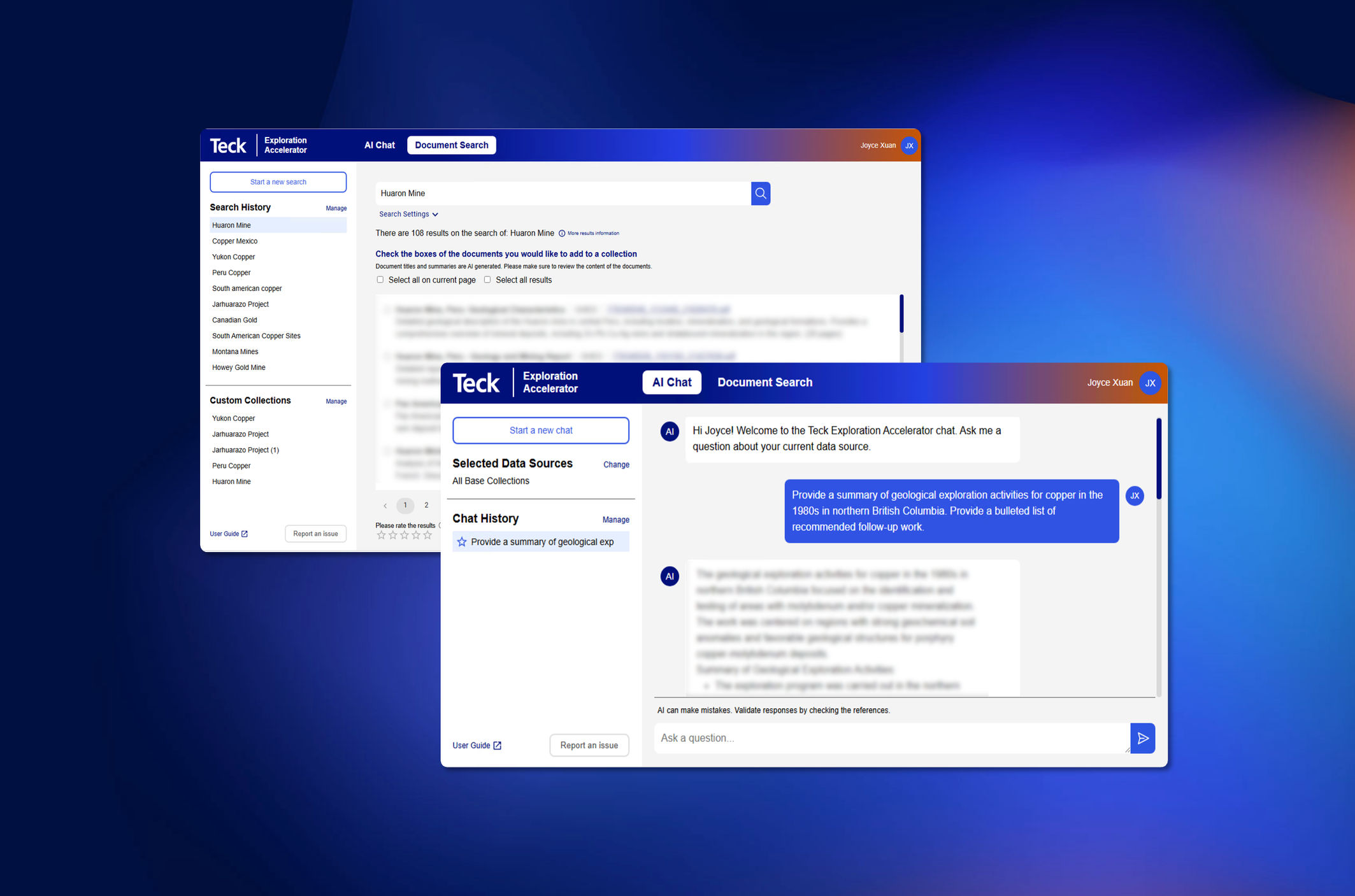
A Generative AI-powered web application leveraging document intelligence and targeting insights for Geologists
The goal of this project was to improve how Teck Exploration Geologists access and interface with unstructured data and insights.
The tool we designed, developed and launched is a Gen-AI chat solution for geologists to search, chat, and discover new areas of interest with over 13 million pages of historical data.
Geologists are now able to search for documents, create document collections, and chat with documents to discover new geological insights that they did not have access to before.
Project Details
Client: Teck Resources
Timeline: 120 days
Pansy’s Role: Lead UX Researcher/Designer
Project Team: Project Manager, Data Science Lead, Lead UX Researcher/Designer, Development Lead, 3 Developers
Stakeholders: Teck VP Exploration, Chief Geoscientist, Product Manager, Applications Architect, 6 Sponsor Users (Exploration Geologists)
Business Outcome:
Leveraged over 13 million pages of historical exploration documents across Teck’s database and summarize existing documented work for past and potential projects
Business Impact:
Increased speed to results by 192x for geologists, enabling them to use natural language to find and extract insights from millions of pages
“It picked up intrusions that I wasn’t aware of... [so] now I can follow up and look into these [geological areas] in more detail. ”
Problem & context
High manual effort and slow decision cycles: Targeting and prioritization relied heavily on manual analysis across large datasets, resulting in days of analyst time per decision cycle.
Under-utilized data: Despite investments in historical data collection and digitization, there was no way for geologists to use the information in an accessible way.
Material opportunity cost at scale: With thousands of potential targets and scenarios to evaluate, there was a need to design an application that could help geologists identify geographical areas of interest more efficiently.
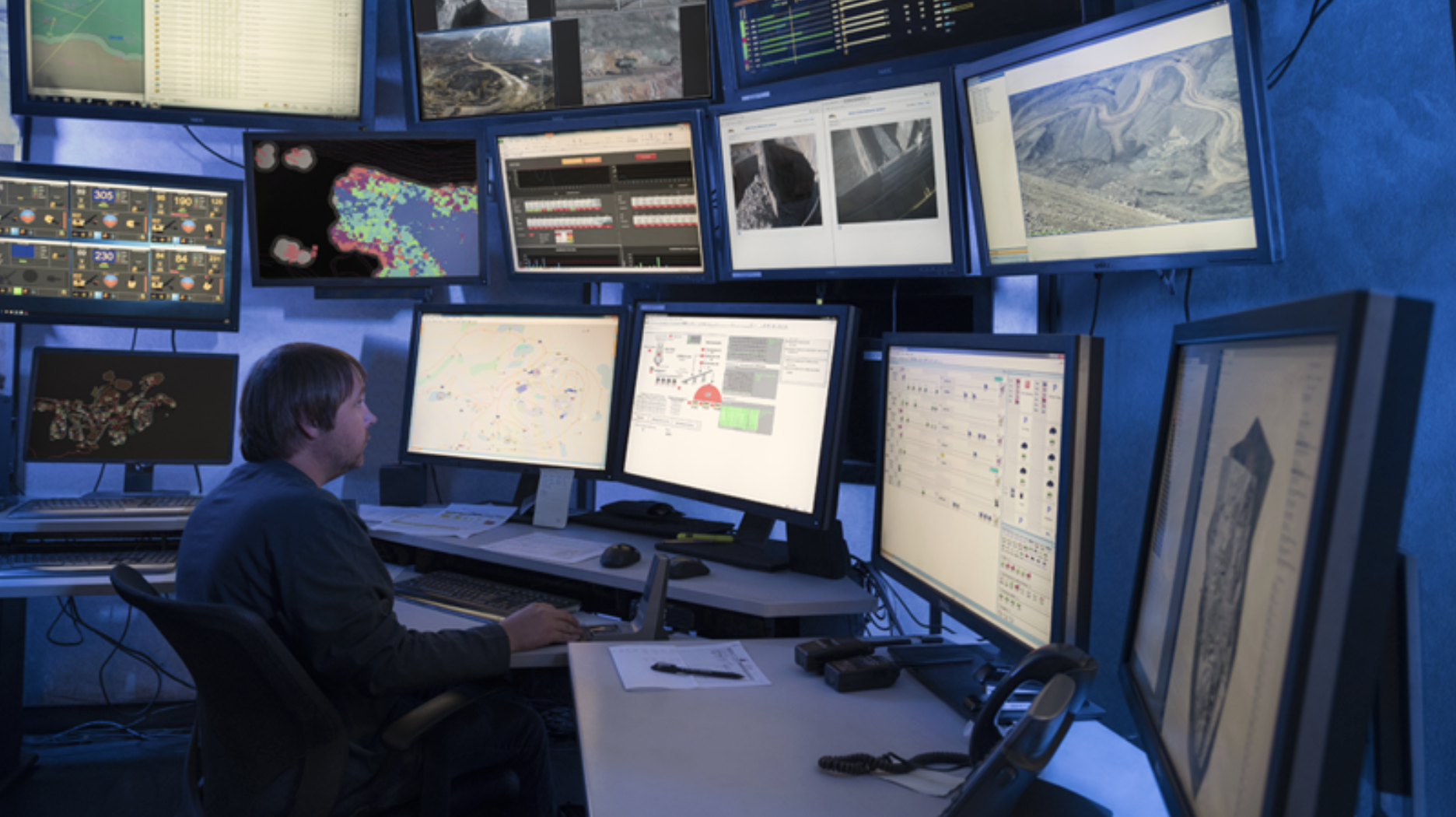
Pansy’s UX Leadership Approach
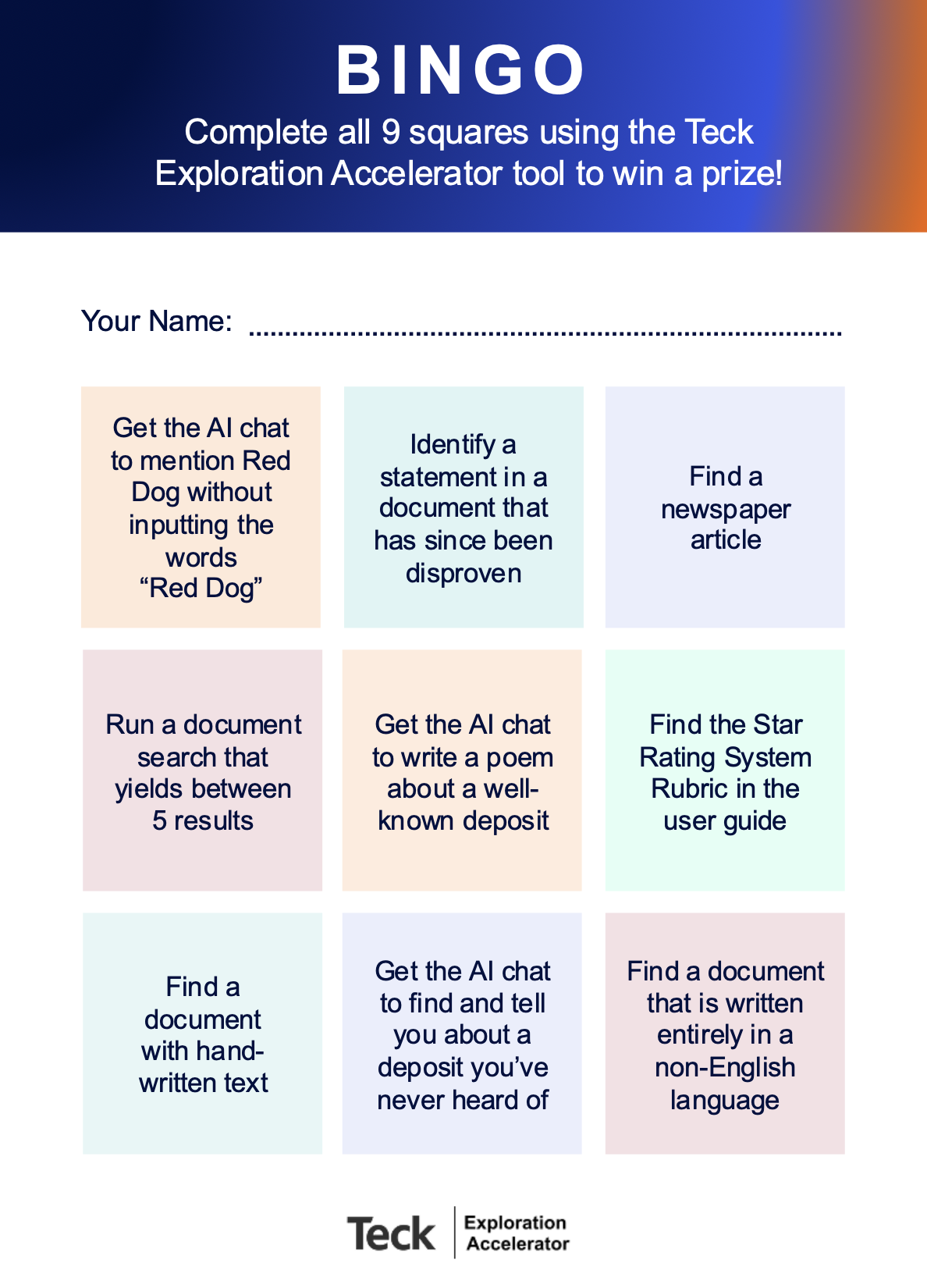
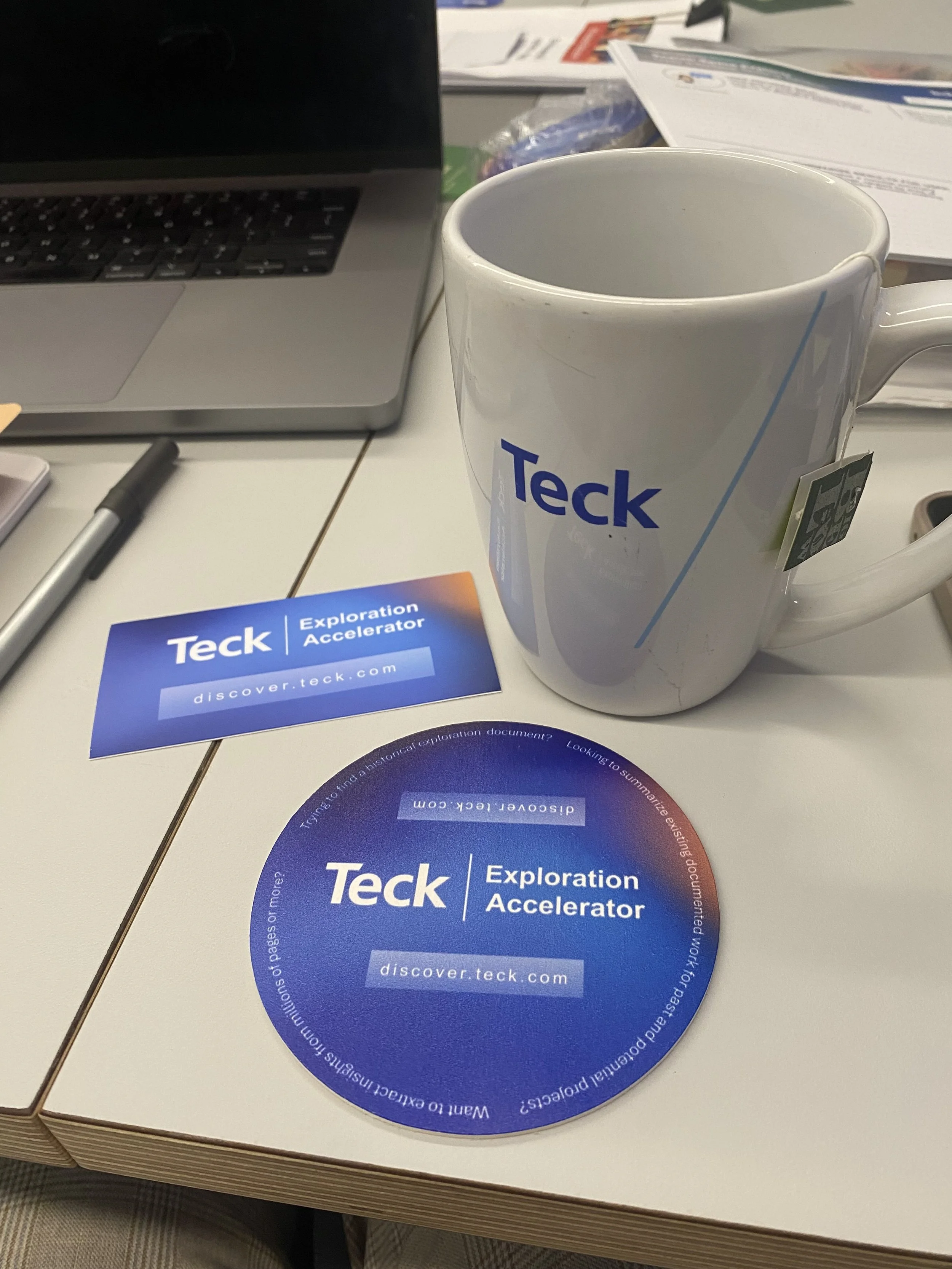
Engaging, human-first leadership: I made adoption approachable and fun by designing playful learning artifacts like desk coasters and bingo cards that helped geologists quickly understand key concepts and workflows.
Bridging deep expertise with new technology: I translated complex AI and analytical concepts into language, visuals, and interactions that resonated with geologists’ existing mental models, enabling them to see the tool as an extension of their expertise rather than a replacement for it.
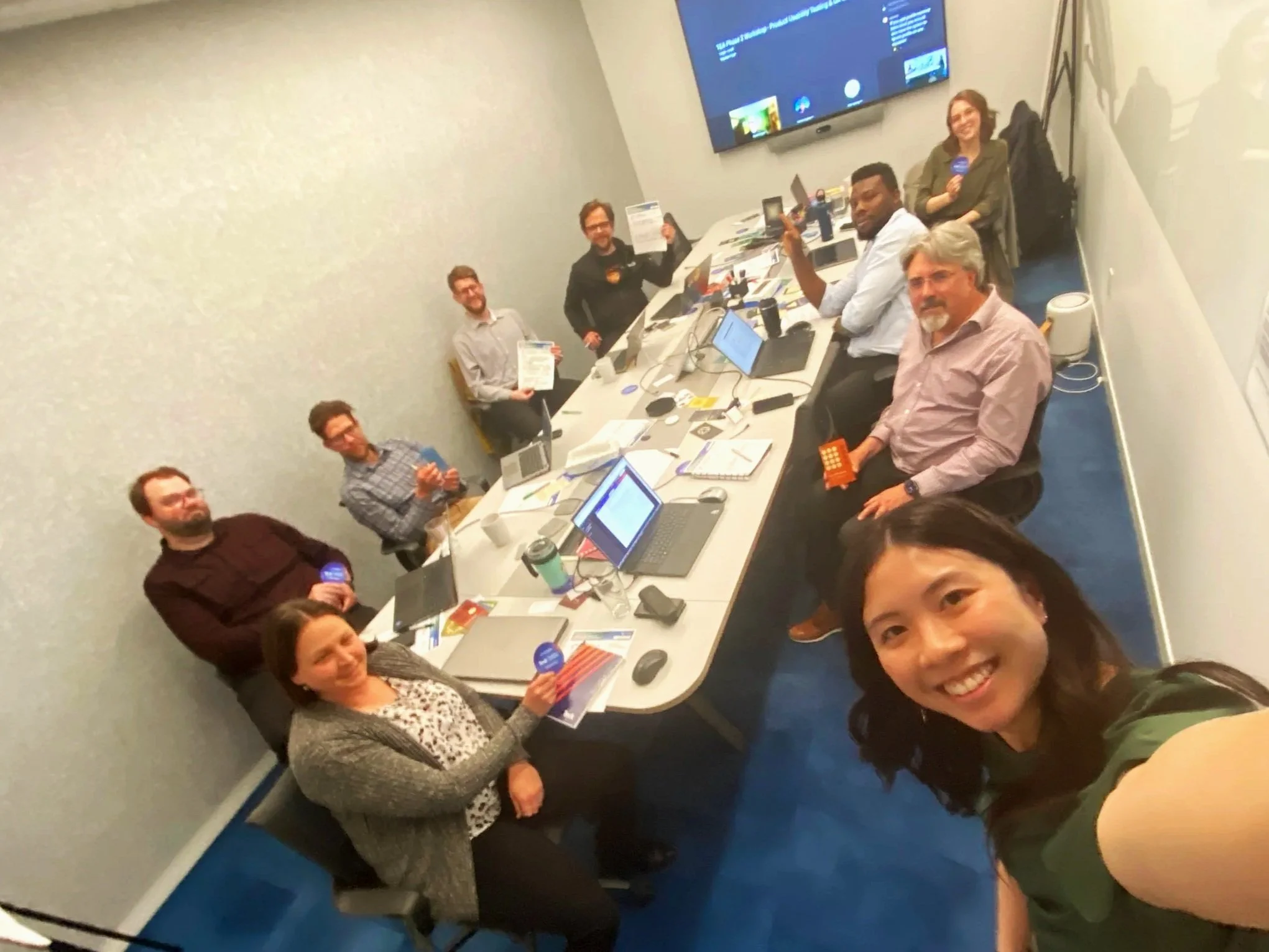
Leading through collaboration and clarity: I created safe, participatory spaces through workshops, user testing, and iterative design reviews, aligning geologists, data scientists, and product partners around a shared vision while maintaining momentum, trust, and a strong sense of ownership across the team.
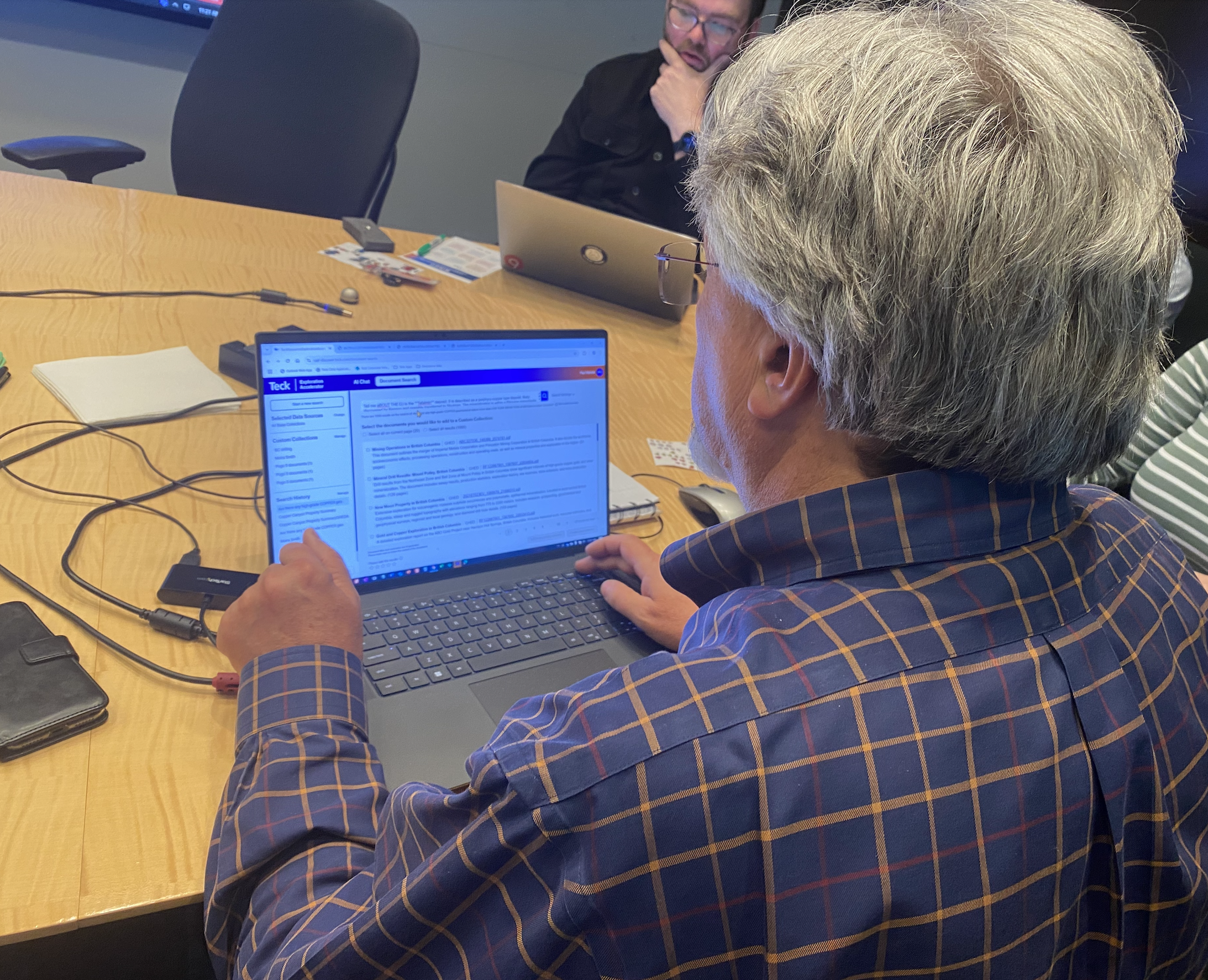
Design for AI and trust through human validation: Conducted usability testing specifically focused on speed to new result. We measured how quickly a geologist could land on a new discovery with the Targeting Insights function versus a manual search.
Pansy’s Impact:
Workshop design and facilitation: I designed and facilitated cross-functional workshops to align Teck stakeholders and data scientists around user needs, AI capabilities, and operational constraints.
AI Targeting Insights interface + user testing: I designed the core interface for the AI Targeting Insights capability and led user-testing sessions to validate usability, trust, and interpretability of AI outputs.
Design system revamp: I refreshed and standardized the visual design system to improve clarity, reduced design debt, and enable faster, more cohesive execution for the dev team.
Designing for AI Explainability: I designed confidence signals and document traceability mechanisms so geologists could see why the AI sourced a document
Methodologies
Design Thinking & Ideation: I led hands-on co-creation sessions with geologists and cross-functional partners, using structured activities to surface needs, test assumptions, and collaboratively shape early concepts through low-fidelity wireframes.
Service Design: Leveraging the quantitative research and ideation outputs, I designed and validated a new workflow for the Insights Generation feature.
User testing with low and mid fidelity prototypes: I designed low-fidelity wireframes to high-fidelity clickable prototypes to test Confidence Signals. We found that geologists didn't just want a summary, they needed a clear "Paper Trail." This led to the design of an expanding source dropdown directly in the AI chat response that linked every insight back to the original document.
A/B Testing: I paired qualitative insights with A/B testing to compare interaction patterns, insight framing, and confidence signals, using quantitative results to refine the interface and optimize for adoption and decision quality.
-
There was a very limited on development capacity to spend on visual design and UX enhancements. Because we were moving into the second phase of the project, we were tasked with designing new features and workflows to add on to the existing tool. During my research with users, I uncovered a number of navigation, discoverability, and usability issues with the Phase 1 Version 1 POC that was negatively impacting the user’s ability to understand and use the tool. With the tight timelines, we had little to no project hours dedicated to make UX/UI enhancements to address the experience debt.
-
Utilizing the results from my user testing sessions and interviews and leveraging Copilot, I recorded all potential UX/UI quality of life changes. Then, I led a facilitation exercise with the development team where we conducted a stack ranking analysis of 'User Value vs. Technical Feasibility”.
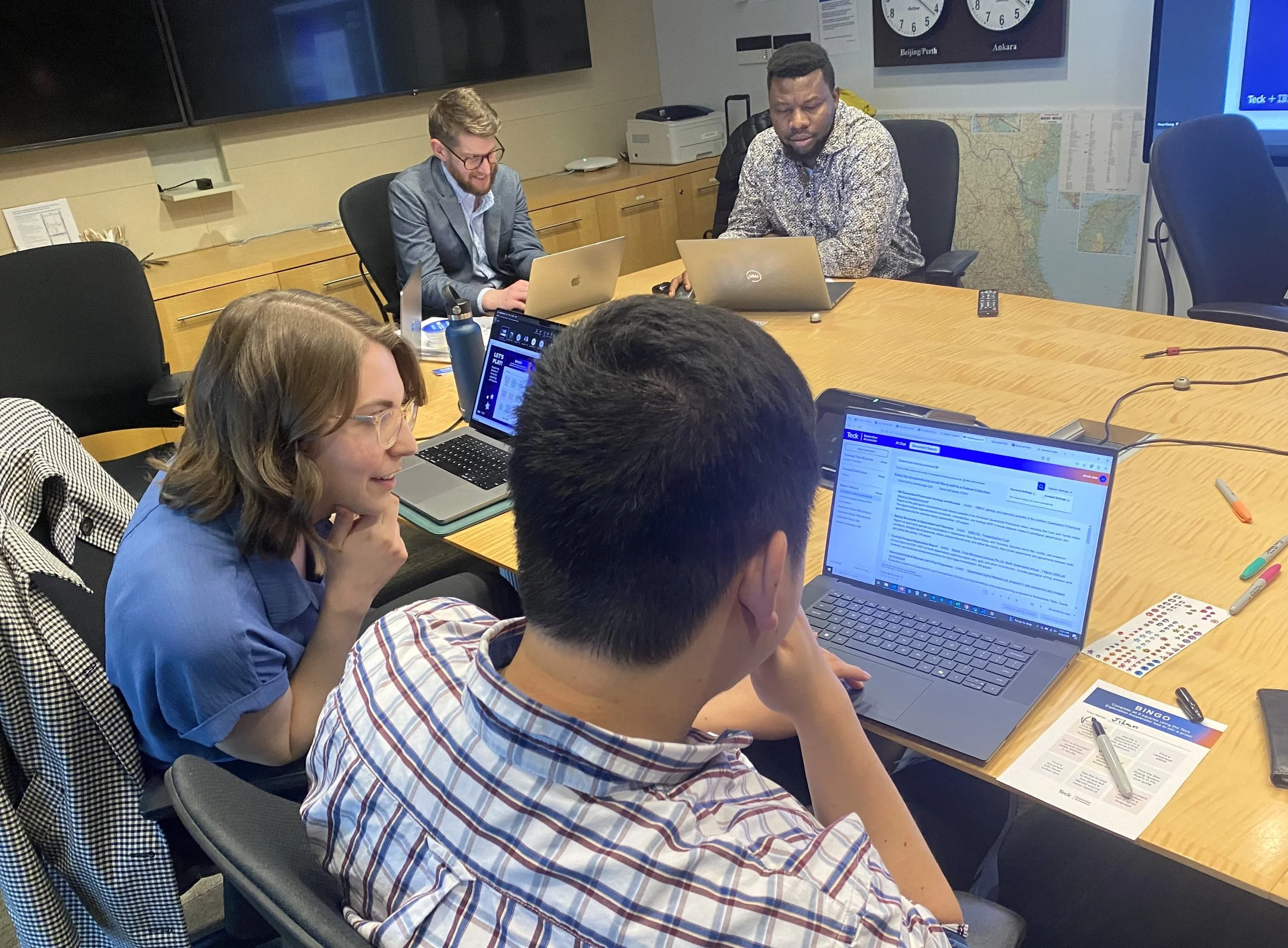
It was also critical to start conducting user tests with geologists that had never heard of or used the tool before for unbiased user research. I initiated and led a New User Adoption Session that brought a new subset of Geologists: junior exploration assistants and interns. They support the senior geologists in doing manual initial research work, and were prime candidates in adopting the use of the tool. -
This led us to prioritize re-designing the elements that would yield the highest ROI for geologists to increase usability, understanding and speed. With my changes, I was able to convince our previously skeptical client stakeholders on the impacts of UX research to foundationally improve the speed to task completion and overall tool satisfaction with our sponsor users, without compromising on the delivery timelines of our new features.
With the new user testing initiative, I found an opportunity to conduct more qualitative research with a new set of users, an increasing total adoption with a new subset of users.
Business Outcome
Leveraged over 300,000 historical exploration documents across Teck’s database and summarize existing documented work for past and potential projects.
Business Impact
Increased speed to results by 192x for geologists by improving readability and speed to action cues, enabling them to use natural language to find, extract, and trace insights from millions of pages more easily than before.
Reflections & Looking Forward
1. Scaling Trust in AI: This project reinforced that transparency is the foundation of adoption. In high-stakes industries like mining, an AI answer is useless without a reason. By designing the Paper Trail feature, I learned that UX's primary job in AI is not just to make things discoverable and usable, but to make the machine’s logic auditable and trustworthy.
2. Design as the Bridge: The Desk Coasters and AI Bingo were more than just fun artifacts, they were strategic tools that served as a reminder to try the tool and to lower the barrier to entry for an extremely technical audience bogged down in their existing workflows. I learned that when introducing disruptive technology, a designer must act as a translator between the data scientist's precision and the user's intuition.
3. Measuring Long-term Success: While the 192x speed increase is a powerful quantitative metric, the qualitative success lies in the cultural shift. Moving forward, I would implement a change adoption study to see how many exploration cycles this tool has been used to replace the old geological workflow of finding targets manually.